
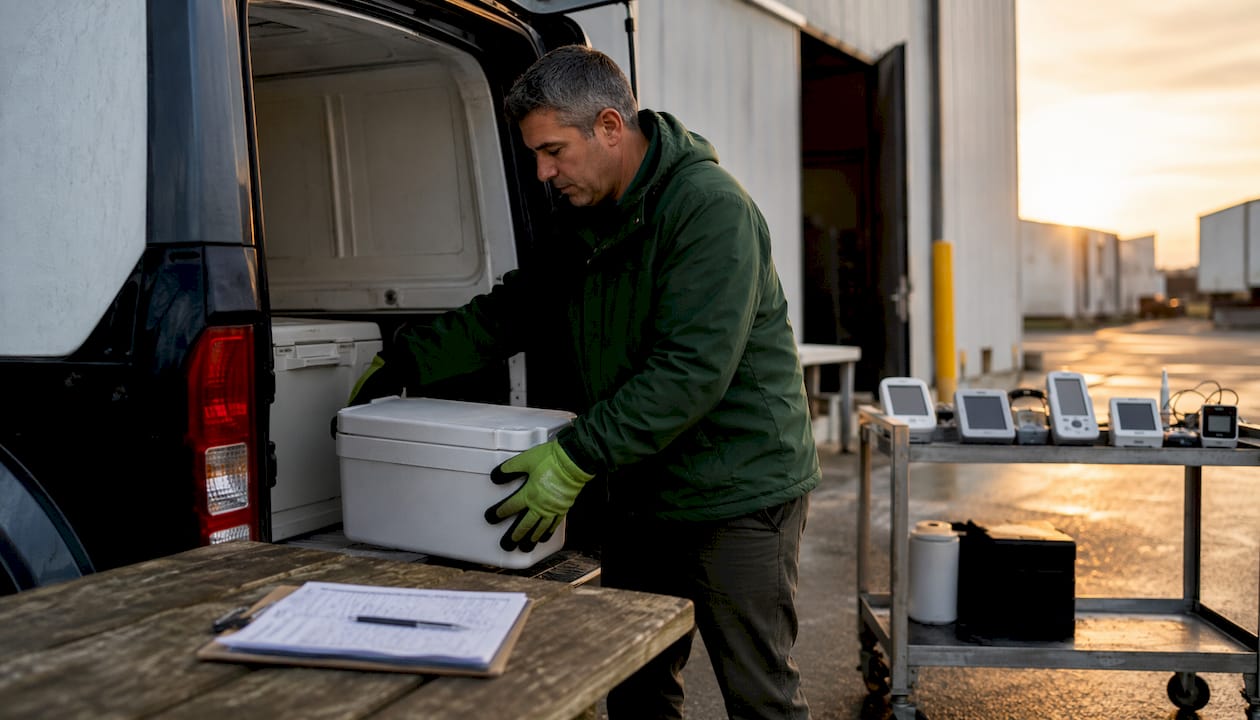
For researchers and enthusiasts in Alabama shipping temperature-sensitive chemicals, five providers stand out: Lineage Logistics, Americold Logistics Birmingham, Dothan Warehouse, Americold Logistics Montgomery, and Q2 Logistics Solutions. Each handles cold chain logistics differently, and the right choice depends on your required temperature range, shipment volume, and whether you need integrated warehousing alongside transport.
| Provider | Services Offered | Specializations | Location | Rating | Temperature Range | Additional Services | Best For |
|---|---|---|---|---|---|---|---|
| Americold Logistics Birmingham | Cold storage, warehousing, distribution | Temperature-controlled warehousing, regional distribution | Birmingham, AL | 4.1★ (78 reviews) | Refrigerated and frozen | Regional cold chain distribution | Research chemical storage and distribution in Alabama |
| Lineage Logistics | Warehousing, transportation, freight forwarding, customs brokerage | Integrated cold chain, fresh and perishable solutions | Alabama (multiple facilities) | 3.1★ (103 reviews) | Full cold chain spectrum | LTL shipping, drayage, direct-to-consumer | Researchers needing full cold chain logistics |
| Dothan Warehouse | Cold storage, ecommerce fulfillment, distribution | Temperature-controlled warehousing 35°F–75°F | Dothan, AL | 4.2★ (71 reviews) | 35°F–75°F | Supply chain technology | Moderate temperature ranges and fulfillment |
| Americold Logistics Montgomery | Cold storage, regional distribution | Regional temperature-controlled storage | Montgomery, AL | 3.2★ (65 reviews) | Refrigerated and frozen | Regional logistics | Localized cold chain storage in central Alabama |
| Q2 Logistics Solutions | Temperature-controlled shipping, logistics | Sensitive goods cold chain shipping | Birmingham, AL | 5★ (11 reviews) | Cold chain shipping | Specialized logistics for sensitive goods | Research chemicals requiring careful cold chain handling |
How do these Alabama providers compare for research chemical shipping?
Americold Logistics Birmingham is the strongest option for researchers who need established cold storage infrastructure with regional distribution reach. The Birmingham facility handles both refrigerated and frozen conditions, making it practical for a wide range of chemical compounds that require strict temperature windows.

Lineage Logistics brings the broadest service portfolio of any provider on this list. Beyond warehousing, it offers integrated cold chain services covering freight forwarding, customs brokerage, LTL shipping, and direct-to-consumer fulfillment. For researchers managing complex supply chains or receiving international shipments of temperature-sensitive chemicals, that breadth is genuinely useful.
Dothan Warehouse occupies a specific niche: its 35°F–75°F range covers the moderate temperature band that many research chemicals require, and its ecommerce fulfillment capability makes it a practical choice for smaller labs ordering direct. It also integrates supply chain technology that gives shippers visibility into inventory and order status.
- Americold Logistics Montgomery serves central Alabama researchers who need localized cold storage without shipping to Birmingham. It is a regional provider with standard cold chain capabilities.
- Q2 Logistics Solutions focuses specifically on sensitive goods shipping in Birmingham. Its narrow specialization means it is built for exactly the kind of careful handling that research chemicals demand.
Pro Tip: When evaluating any provider, ask specifically whether they maintain temperature logs throughout the entire shipment, not just at pickup and delivery. A provider that can show you a continuous temperature record gives you documentation that protects both your research and your liability.
How to choose the right temperature-controlled shipping provider for research chemicals
The most important criterion is whether the provider’s temperature range actually matches your compound’s stability requirements. Many research chemicals degrade outside a narrow window, so a provider that only offers generic “refrigerated” service without specifying the maintained range is a risk.
Key selection criteria:
- Temperature range verification: Confirm the provider can maintain your exact required range, whether that is 2°C–8°C for many biologics, sub-zero for certain compounds, or the 35°F–75°F moderate band.
- Transit time: For temperature-sensitive shipments, every extra hour in transit is a liability. Express courier services typically deliver in 1–5 business days domestically; standard services can stretch to 21 days for international routes.
- Packaging method: Active systems use refrigerated vehicles with electronic temperature control. Passive systems use insulated containers with gel packs or dry ice. Active is better for high-value or zero-tolerance compounds; passive works for shorter transits.
- Dry ice handling: Dry ice maintains sub-zero temperatures but requires venting. Containers must never be sealed airtight due to CO2 pressure buildup, and product should not contact dry ice directly to avoid freeze damage.
- Gel pack ratio: A practical baseline is one pound of gel pack per two pounds of product to maintain temperature across transit. Gel packs are safer to handle than dry ice and work well for the 35°F–75°F range.
- Monitoring and tracking: Real-time IoT temperature sensors that alert you to excursions mid-transit are the standard for serious cold chain work. Combining insulated packaging with real-time temperature monitoring gives the best assurance of product integrity.
- Insurance and liability: Confirm the provider’s liability coverage for temperature excursions. Most standard carrier policies do not cover chemical degradation from temperature failure. Separate cargo insurance for temperature-sensitive shipments is worth the cost.
- Regulatory compliance: Verify the provider understands US DOT and IATA requirements for your specific chemical class before booking.
Cold chain shipping costs more than standard shipping because of the specialized equipment, monitoring overhead, and tighter scheduling that refrigerated logistics require. Budget accordingly, and treat the premium as insurance on your compound’s integrity.
What is temperature-controlled shipping, and why does it matter for research chemicals?
Temperature-controlled shipping, also called cold chain logistics, is the practice of maintaining a specific temperature range for goods throughout every stage of transit, from packing through final delivery. For research chemicals, this is not a convenience feature. Many compounds degrade, react, or lose efficacy entirely when exposed to temperatures outside their stability range, even briefly.
The two main approaches are active and passive systems. Active systems use refrigerated vehicles or containers with electronic controls, making them the right choice for high-value compounds where any temperature variation is unacceptable. Passive systems rely on insulated containers with gel packs or dry ice, which work well for shorter transits and moderate temperature requirements.
USPS offers a Priority Mail Express Cold Chain packaging option that maintains temperatures at 45°F or below for up to 72 hours. That window covers many domestic shipments, but for longer routes or more demanding temperature requirements, a dedicated cold chain provider is the better call.
Cold chain logistics principles every researcher should know
The core principle of cold chain logistics is the uninterrupted temperature record. Every touchpoint, from the moment you pack a compound through storage, transport, and final delivery, must stay within the validated range. A single excursion can compromise an entire batch.
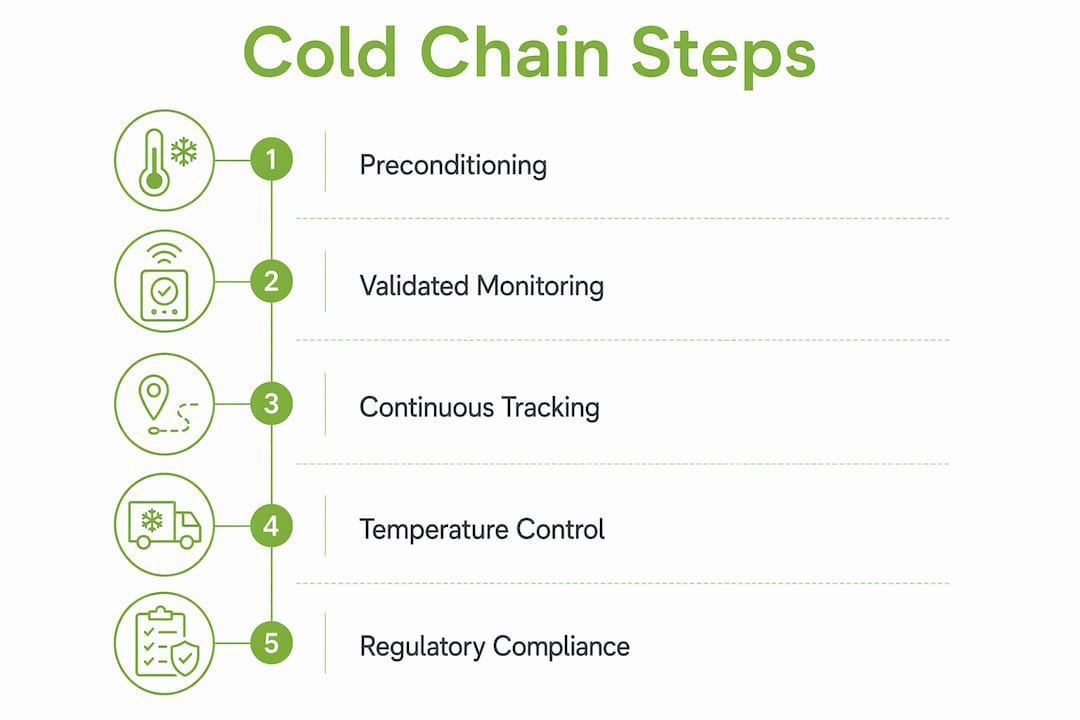
Validated monitoring is what separates a real cold chain from a best-effort one. Providers using IoT sensors and GPS-linked temperature loggers can produce a continuous record of conditions throughout transit. That record matters both for research integrity and for any regulatory documentation your work requires.
Pre-conditioning matters more than most researchers expect. Loading warm product into a cold container, or a cold container into a warm truck, creates a temperature spike at the start of transit that passive cooling may not recover from. Good providers pre-cool both the container and the product before loading.
What US regulations apply to shipping research chemicals?
Research chemicals in the US fall under several overlapping regulatory frameworks depending on their classification. The Department of Transportation (DOT) governs hazardous materials transport under 49 CFR, which covers labeling, packaging, and documentation requirements for chemicals that meet the definition of hazardous materials. Many research chemicals qualify.
For air shipments, IATA’s Dangerous Goods Regulations set the standard. Carriers like FedEx and UPS require IATA-compliant packaging and documentation for any chemical classified as a dangerous good, and non-compliance typically results in shipment refusal or seizure. The DEA schedules certain research chemicals as controlled substances, adding a separate layer of licensing and documentation requirements.
The FDA’s guidelines on pharmaceutical and chemical transport emphasize maintaining specific temperature ranges and complete documentation from origin to destination. Even if your compound is not a pharmaceutical, those documentation standards are a useful baseline for protecting your shipment and your research record.
For international shipments, customs documentation accuracy is the single biggest variable in transit time. Incomplete paperwork is the most common reason parcels get held at customs, and for research chemicals, a hold can mean temperature excursion and lost product. Get the classification codes, declared values, and safety data sheets right before the package moves.
Chemlabshop-online ships research chemicals with cold chain support built in
If you need the chemicals themselves, not just a shipping provider, Chemlabshop-online is a direct source for research-grade chemicals with temperature-controlled shipping support already factored into the order process.

The catalog covers a broad range of synthetic substances and specialty compounds, with pricing from $150 to $10,000 depending on the product. Cryptocurrency payments receive a 20% discount, and the purchasing process is designed to be discreet. Chemlabshop-online handles the shipping and returns logistics for temperature-sensitive orders, so you are not coordinating separately between a supplier and a cold chain provider. Check the shipping and returns policy for current transit times and temperature handling details before placing an order.
Key Takeaways
For research chemicals in Alabama, the best cold chain outcome comes from matching your compound’s exact temperature requirement to a provider’s verified range, not just their general “cold storage” claim.
| Point | Details |
|---|---|
| Match temperature range precisely | Confirm the provider maintains your exact required range, whether 2°C–8°C, sub-zero, or 35°F–75°F. |
| Active vs. passive systems | Active refrigerated systems suit zero-tolerance compounds; passive gel pack or dry ice systems work for shorter, moderate-temperature transits. |
| Gel pack ratio baseline | Use one pound of gel pack per two pounds of product as a starting point for maintaining temperature across transit. |
| Regulatory compliance is non-negotiable | DOT, IATA, and DEA requirements apply to many research chemicals; incomplete documentation is the top cause of customs delays and shipment holds. |
| Chemlabshop-online | Direct source for research-grade chemicals with temperature-controlled shipping and a 20% discount for cryptocurrency payments. |


0 Comment