

Why humidity control storage protects what temperature alone cannot
Humidity control storage is the active management of moisture levels inside a storage environment, keeping relative humidity (RH) within a defined range so sensitive materials do not degrade, corrode, or lose integrity. Temperature control handles heat. Humidity control handles water vapor. Those are two separate problems, and confusing them is the single most common and costly mistake in storage planning.
Standards like JEDEC J-STD-033 and ANSI/ESD S20.20 exist precisely because moisture damage in electronics and research materials is predictable and preventable. The core components of any effective system include:
- Dehumidifiers or HVAC systems with active moisture removal
- Desiccants (silica gel, molecular sieve, or clay) for passive absorption inside sealed packaging
- Moisture barrier bags, including mylar moisture barrier bags, to isolate materials at the package level
- Humidity indicator cards to verify conditions inside sealed enclosures
- Continuous monitoring with digital hygrometers or data loggers
Poor humidity control leads to mold growth, metal corrosion, chemical degradation, and in semiconductor applications, the “popcorning” delamination that JEDEC J-STD-033 was written to prevent.
Effective methods for controlling moisture in storage environments
Active and passive methods work best together. Neither alone is sufficient for truly sensitive materials.
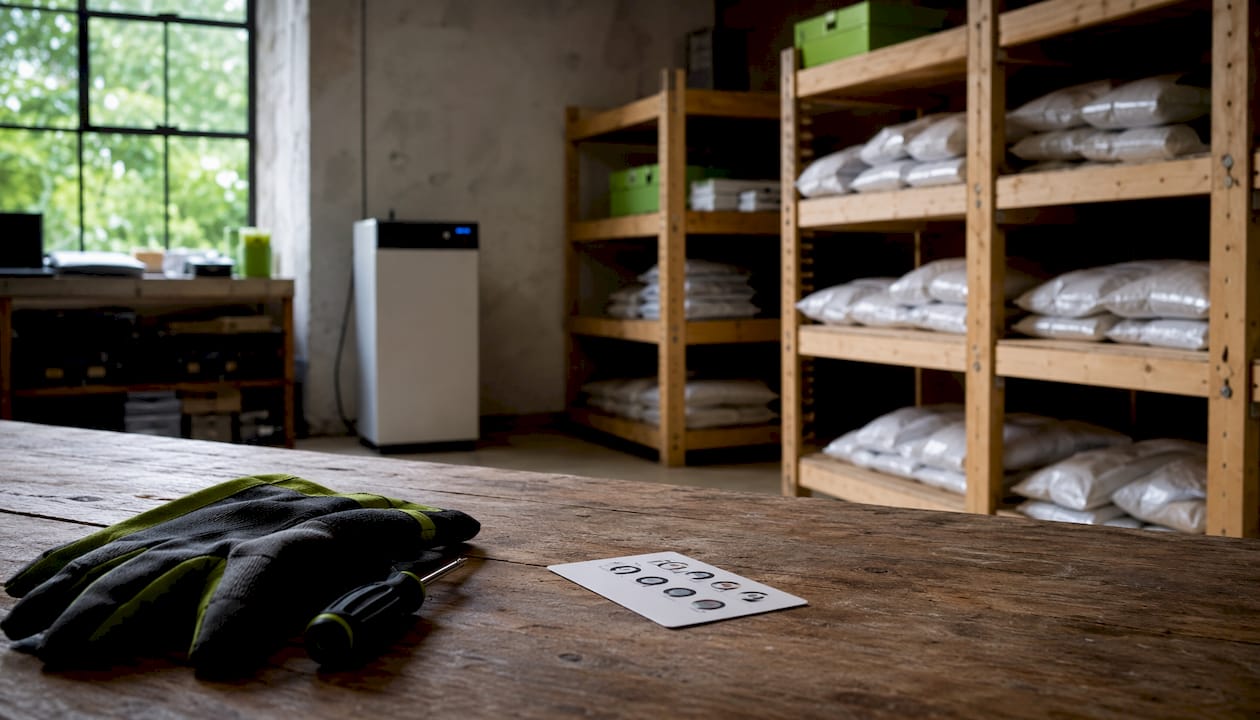
Active methods use powered equipment to remove or add moisture from the air. A dedicated dehumidifier or a properly configured HVAC system can hold a room at 30–50% RH, which covers most general storage needs. For research chemicals and electronic components, tighter control is often required.
Passive methods work at the package level and do not require power:
- Desiccants for powders and chemicals: Silica gel absorbs moisture across a broad RH range and is easy to regenerate by heating. Molecular sieve desiccants adsorb at lower RH levels, making them better for applications requiring very dry conditions. Knowing how much desiccant to use matters: the quantity depends on the internal volume of the sealed package and the target RH, not just the weight of the contents.
- Moisture barrier bags: High-quality barrier bags have thicknesses of 3.6 mil to 7.0 mil and a moisture vapor transmission rate (MVTR) as low as 0.03 grams per 100 square inches. Mylar moisture barrier bags are a common choice because the foil laminate layer delivers that low MVTR reliably.
- Vacuum sealing: Removing trapped air before heat-sealing a moisture barrier bag drastically reduces residual moisture and slows ingress over time.
- Humidity indicator cards: These cards use moisture-sensitive chemicals to signal RH thresholds, typically 5%, 10%, and 60% RH. They change color from blue to pink when the threshold is exceeded. Choose cobalt-free cards to meet health and safety requirements; cobalt(II) chloride is classified as toxic under EU REACH standards, and cobalt-free alternatives are now widely available and preferred.
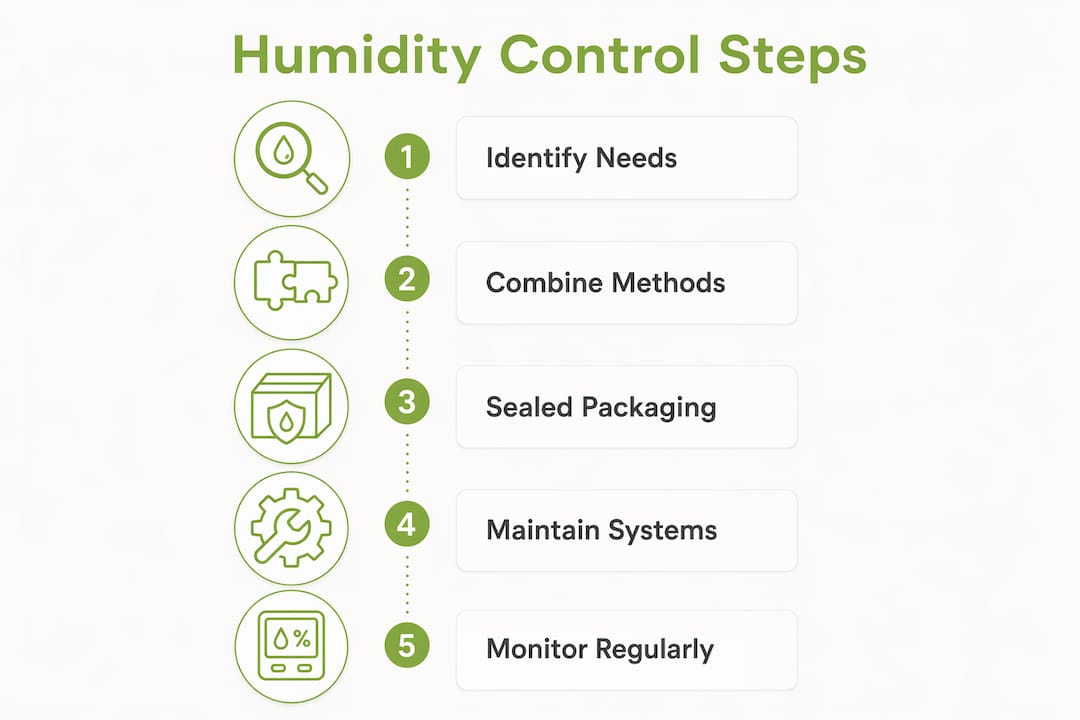
Pro Tip: Combine room-level dehumidification with individually sealed moisture barrier bags containing desiccant and a humidity indicator card. The room control handles ambient conditions; the sealed package is the last line of defense if the room system fails or a door is left open.
Maintenance keeps active systems reliable. Clean dehumidifier coils quarterly, replace desiccant packs before they saturate, and log hygrometer readings at least weekly for critical storage areas.
Common mistakes that undermine humidity control in storage
Most humidity control failures trace back to a handful of recurring errors.
- Treating climate control and humidity control as the same thing. Climate-controlled storage typically maintains temperatures between 55–85°F but may not include active dehumidification. Always ask a facility operator specifically whether dehumidification equipment is installed and running.
- Relying on temperature control to manage moisture. Industrial climate control specialists are consistent on this point: active water vapor removal requires desiccant systems or dedicated dehumidifiers, not just HVAC.
- Misreading humidity indicator cards as active controllers. A card tells you what the RH has been. It does not lower humidity. Treating a blue card as confirmation that everything is fine, without checking the desiccant load or seal integrity, is a false sense of security.
- Ignoring seal and insulation integrity. Even a well-designed HVAC system cannot compensate for a compromised door seal or cracked wall panel. Secondary packaging inside the unit is the practical fix.
- Using too little desiccant. How much desiccant to use is a calculation, not a guess. Undersized desiccant loads saturate quickly and stop absorbing, leaving materials exposed.
- Skipping vacuum sealing on barrier bags. A heat-sealed bag with trapped humid air is not a dry package. Vacuum first, then seal.
- Neglecting equipment maintenance. A saturated desiccant pack or a clogged dehumidifier coil provides no protection at all.
- Ignoring JEDEC and ANSI standards for sensitive materials. These standards exist because the failure modes are well-documented. Following them is not optional for research-grade or semiconductor applications.
Top climate-controlled storage facilities in Alabama for sensitive materials
Alabama’s humidity, especially in summer, makes active moisture management a practical necessity rather than a premium add-on. These five facilities offer climate-controlled storage relevant to sensitive materials and equipment.
-
Space Savers HWY 280 serves the Birmingham corridor and offers indoor climate-controlled units suited for both personal and commercial storage needs. Verify directly with the facility whether active dehumidification is part of their climate system.
-
AAA Climate Control Storage in Cottondale, AL provides indoor climate-controlled and commercial storage with 24-hour access. Their focus on commercial clients makes them a practical option for researchers and businesses storing equipment or inventory long-term. Specific pricing is not publicly listed.
-
Storage Sense, Millbrook, Oak Tree in Millbrook, AL offers climate-controlled indoor units with rollup interior doors and ground-level drive-up access. Pricing runs approximately $89–$124 per month after promotional periods, with a first-month-free flash sale available on select units.
-
Curry Climate Storage near Smith Lake, AL is a newly built facility with Bluetooth electronic building access and an 8×11 roll-up dock door for large items. They offer both business and personal storage units. Pricing is not publicly listed.
-
Dover’s Climate Controlled Storage in the Jasper, AL area provides climate-controlled self-storage with 24/7 secure access. Specific pricing is not publicly listed.
Before signing a rental agreement at any facility, ask these questions directly:
- Does the unit have active dehumidification, or only temperature control?
- What is the target RH range maintained in the units?
- Can you provide that commitment in writing?
For research chemicals and moisture-sensitive powders, the answer to the first question determines whether the facility is actually suitable.
Expert perspective from Chemlabshop-online on storing research chemicals safely
Chemlabshop-online works with researchers and enthusiasts who store research chemicals and specialty powders, materials where moisture control is not a background concern but a direct factor in product integrity.
Proper humidity control for research chemical storage means layering protections: a controlled environment at the room level, sealed moisture barrier bags with calibrated desiccant quantities inside, and humidity indicator cards that give you a verifiable record of conditions. Standards like JEDEC J-STD-033 and ANSI/ESD S20.20 were built for electronics, but the underlying logic applies equally to hygroscopic powders and reactive compounds. One compromised seal or one saturated desiccant pack can degrade a sample that took significant time and cost to source.
Cobalt-free humidity indicator cards are the standard Chemlabshop-online recommends for any application involving research materials, both for safety compliance and because the color-change accuracy of modern cobalt-free formulations is reliable at the 5% and 10% RH thresholds that matter most for sensitive compounds.
For researchers sourcing materials, Chemlabshop-online’s research chemicals catalog pairs product quality with guidance on storage requirements, so you know what conditions each substance needs before it arrives.

Key Takeaways
Effective humidity control storage requires layered protection: sealed packaging with desiccant, verified humidity indicator cards, and active room-level dehumidification working together.
| Point | Details |
|---|---|
| Climate control ≠ humidity control | Facilities may only regulate temperature; always confirm active dehumidification is present. |
| Target RH range | Most sensitive materials require storage between 30–50% RH for reliable protection. |
| Barrier bag MVTR matters | High-quality moisture barrier bags achieve MVTR as low as 0.03 g/100 sq in; lower is better. |
| Desiccant quantity is a calculation | Volume of the sealed package determines how much desiccant to use, not just material weight. |
| Cobalt-free cards are the standard | Choose cobalt-free humidity indicator cards for safety compliance and accurate RH readings. |


0 Comment