
Why lab ventilation basics determine whether your workspace is safe
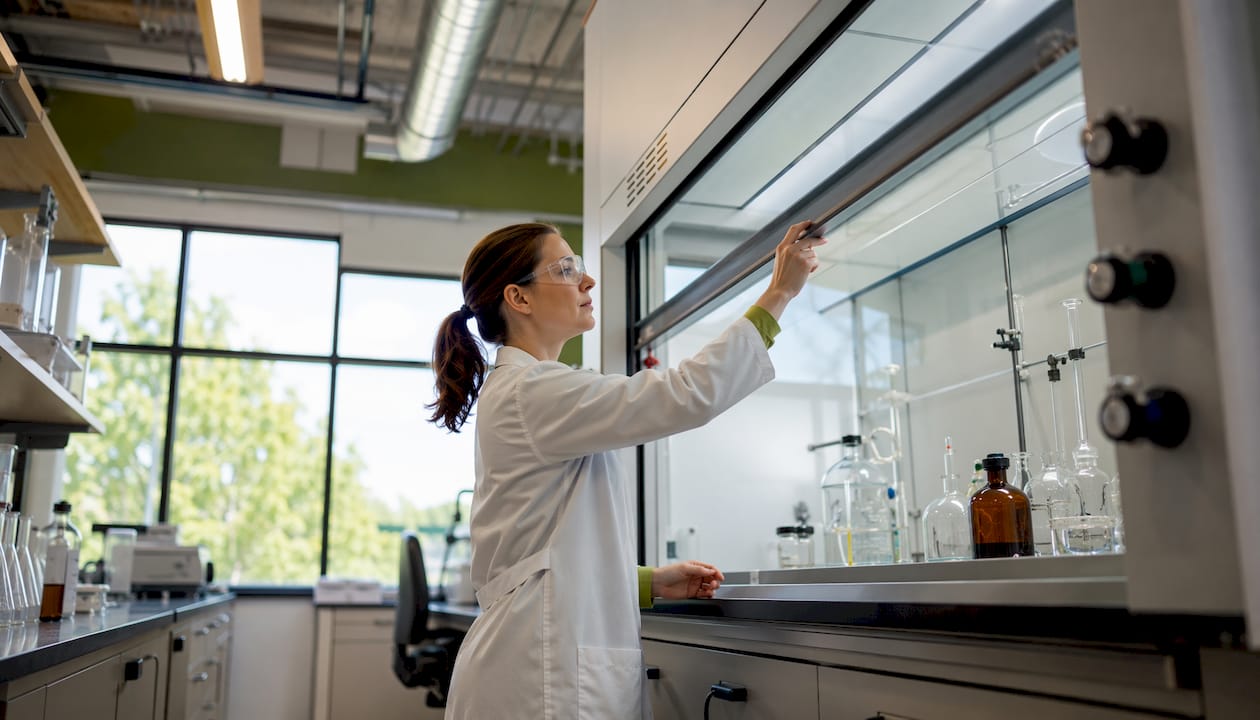
Laboratory ventilation is an engineered system, not a passive feature. Its job is to remove hazardous airborne contaminants, maintain controlled pressure differentials, and protect everyone in the space from chronic or acute chemical exposure. If you’re working with research chemicals or synthetic substances, the ventilation design you choose is as consequential as the chemicals themselves.
The core principles every researcher needs to understand:
- Negative pressure is non-negotiable. Labs must exhaust more air than they supply, creating a slight vacuum that pulls air inward from adjacent corridors rather than letting contaminants escape outward. The ACS Basics of Laboratory HVAC guide makes this the foundational design requirement.
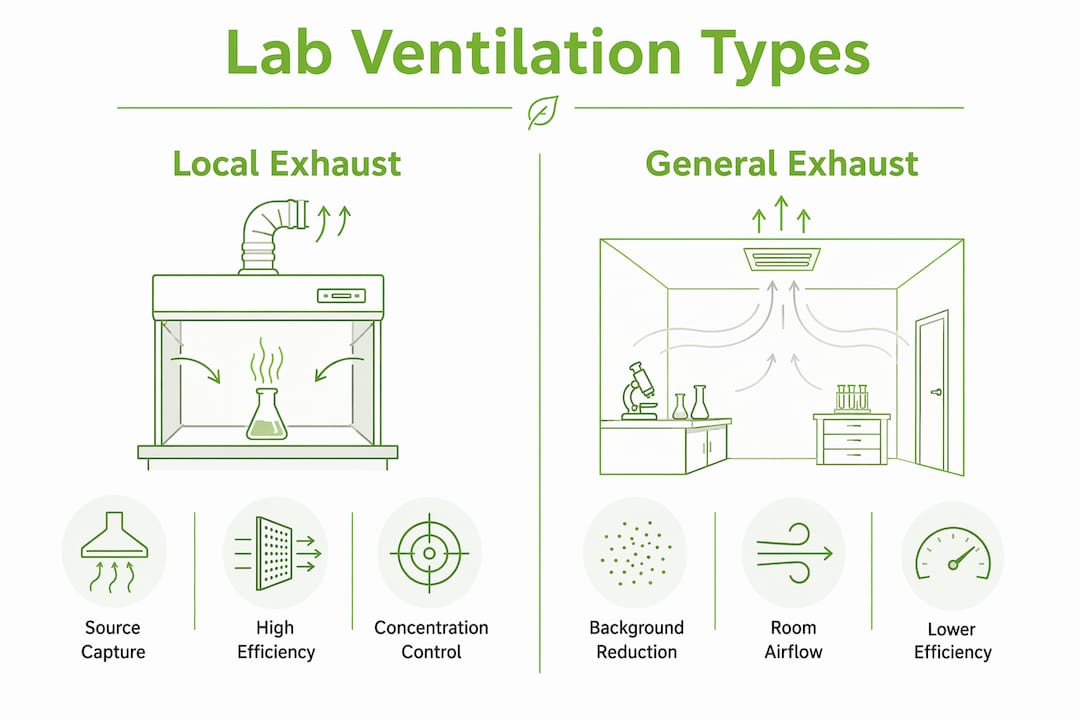
- Local Exhaust Ventilation (LEV) sits at the top of the control hierarchy. It captures contaminants at the emission source before they disperse into the room. Per OSHA’s laboratory ventilation guidance, LEV is significantly more efficient than dilution-based approaches.
- General Exhaust Ventilation (GEV) dilutes ambient air across the whole lab space. It handles background contamination but cannot substitute for LEV when working with acutely hazardous materials.
- System design must match your chemistry. A ventilation setup calibrated for one chemical class may be wholly inadequate for another. The ACS HVAC guide is explicit: using a lab with ventilation not designed for your current chemicals risks safety due to insufficient airflow or filtration capacity.
- US regulatory standards apply. OSHA’s laboratory standards and ANSI/AIHA Z9.5 govern lab ventilation design and operation. These are not suggestions — they set the floor for acceptable practice.
Table of Contents
- How local exhaust ventilation and general exhaust ventilation actually differ
- Ducted vs. ductless fume hoods: how to choose the right one
- What makes a laboratory ventilation system actually perform
- How to commission and maintain ventilation systems that stay safe
- Key Takeaways
How local exhaust ventilation and general exhaust ventilation actually differ
LEV captures contaminants at the source, making it far more efficient than GEV, which simply dilutes contaminated air throughout the workspace. That distinction drives every practical decision about lab airflow design.
LEV components and function:
- A hood or enclosure where contaminants enter the system
- Ducting that transports contaminated air to a filter or exhaust point
- An air cleaner, filter, or scrubber matched to the contaminant type
- A fan to power the extraction
- A discharge point that vents to a safe location
GEV function and appropriate use:
- Dilutes residual contamination by mixing lab air with fresh supply air
- Expressed as Air Changes per Hour (ACH); occupied labs typically run a moderate number of air changes per hour
- Appropriate for lower-hazard scenarios or as a backup layer alongside LEV
- Cannot control point-source emissions from reactive or volatile chemicals
The practical advantage of LEV is concentration control at the source. GEV can reduce background levels, but by the time dilution does its work, a researcher working directly over an open vessel has already been exposed. For anyone handling research chemicals with significant vapor pressure or acute toxicity, LEV is the primary control, not an optional upgrade.
Pro Tip: Hood design and airflow rate must account for the specific vapor density and particulate behavior of your chemicals. A hood sized for light organic vapors may fail to capture heavier-than-air compounds that pool at bench level.
Ducted vs. ductless fume hoods: how to choose the right one
The ducted vs. ductless hood decision is one of the most consequential choices in lab setup. Ducted hoods vent fumes, heat, and moisture completely outside the building. Ductless hoods filter and recirculate air internally using activated carbon or HEPA filtration.
Ducted fume hoods:
- Universally recommended for research involving hazardous, reactive, or high-vapor-pressure chemicals
- Handle heat, moisture, and mixed chemical streams without filtration saturation concerns
- Require external ductwork, which adds installation complexity and cost
- Generally quieter in operation than ductless alternatives
- Long service life with minimal maintenance beyond periodic duct inspection
Ductless fume hoods:
- Suitable only where external ducting is structurally impossible or for light-duty work with well-characterized, low-hazard chemicals
- Filtration capacity is finite; carbon filters saturate and must be replaced on schedule
- Cannot handle unknown chemical mixtures, because no single filter medium captures every compound class
- Lower upfront cost and simpler installation, but higher ongoing filter replacement costs
- Not appropriate for work with carcinogens, highly toxic compounds, or reactive substances
The core limitation of ductless systems is chemical specificity. Carbon filters are selected for known contaminant profiles. If your research involves variable or novel synthetic substances, a ductless hood creates a false sense of security. Ducted systems remove the uncertainty entirely by exhausting everything outside.
Match hood selection to chemical vapor pressure, volume used, and hazard classification. A low-volatility compound in milligram quantities is a different risk profile than a high-vapor-pressure solvent used in gram-scale synthesis.
What makes a laboratory ventilation system actually perform
Design is where most ventilation failures originate. Equipment that looks adequate on paper can underperform badly if the system integration is wrong.
Makeup air and negative pressure:
Makeup air replaces the volume exhausted by hoods and room exhaust, maintaining the negative pressure differential that keeps contaminants inside the lab. Without adequate makeup air, exhaust systems lose efficiency, face velocity drops, and backflow from adjacent spaces becomes possible. This is one of the most frequently overlooked elements in lab airflow design.
Key performance metrics:
- Air Changes per Hour (ACH): The total air volume supplied per hour divided by room volume. Occupied labs typically target 8–10 ACH.
- Face velocity: The speed of air entering the fume hood sash opening, typically 80–120 feet per minute. Fume hood sash position and supply air diffuser location both affect this directly.
- Pressure differential: The measurable difference between lab and corridor pressure, confirming negative pressure is maintained.
System types and trade-offs:
Constant Volume (CV) systems supply and exhaust fixed airflow regardless of occupancy or hood use. They are straightforward to control and well-suited to ventilation-driven labs. Variable Air Volume (VAV) systems adjust airflow to match demand. VAV fume hoods reduce exhaust when sashes are lowered, cutting energy costs while maintaining face velocity. The trade-off is greater control system complexity and the need for reliable sensors.
Pro Tip: Vapor density determines extraction placement. Compounds heavier than air require low-level extraction like downdraft tables. Lighter-than-air vapors need overhead capture devices. Getting this wrong means the hood draws air away from the contaminant cloud, not through it.
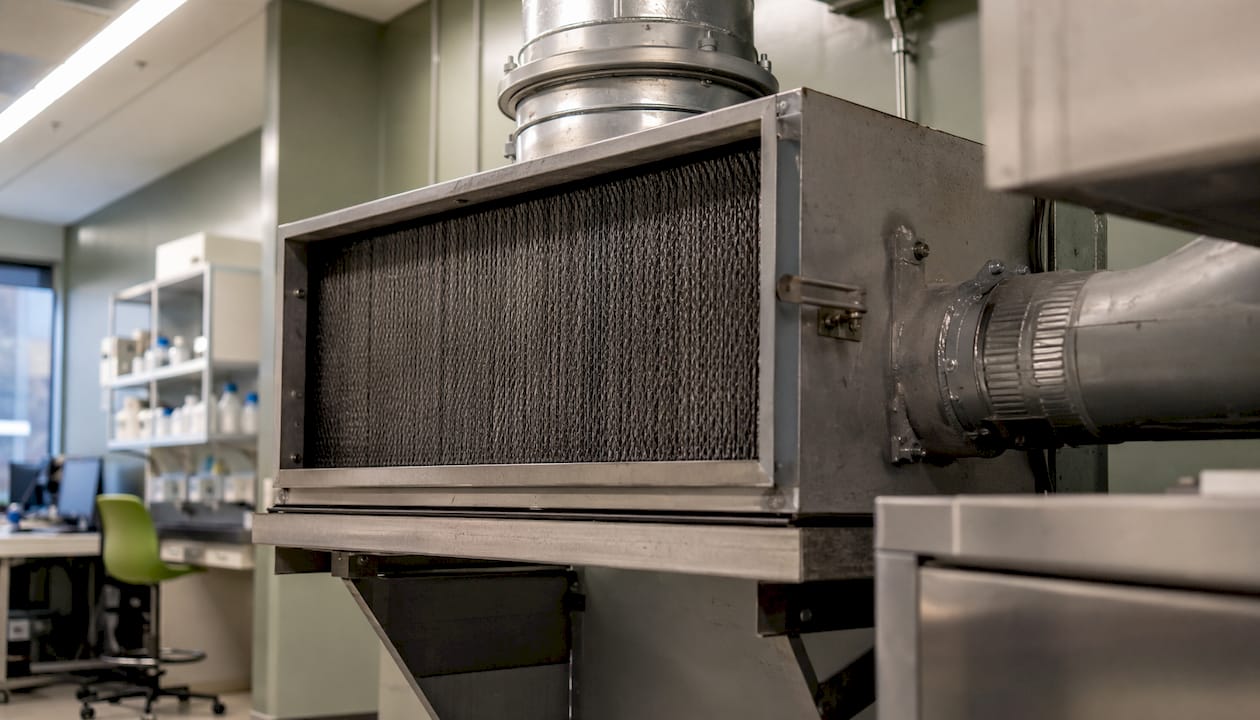
Involving a certified industrial hygienist or ventilation engineer in system design is not optional for serious research environments. The interaction between hood type, makeup air volume, room geometry, and chemical properties is too complex for trial-and-error.
Integration with fire safety and emergency systems:
Ventilation systems must coordinate with fire suppression and emergency shutdown protocols. In a fire event, some systems switch to full exhaust mode to clear combustion products; others shut down to prevent spreading flames through ductwork. Your system design needs to specify this behavior explicitly, and it must be tested as part of commissioning.
How to commission and maintain ventilation systems that stay safe
Design alone does not guarantee safety. Effective lab ventilation requires regular commissioning, maintenance, and clear protocols enforced with trained personnel. A system that tested correctly at installation can degrade silently over months.
Commissioning steps:
- Professional installation verified against design specifications
- Airflow measurement at every hood and exhaust point
- Pressure differential confirmation across all lab boundaries
- Documentation of baseline performance metrics for future comparison
Routine maintenance tasks:
- Filter inspection and replacement on schedule, not just when performance degrades
- Annual system testing including fan bearing checks, duct cleaning, and airflow verification
- Inspection of duct integrity for deposits, corrosion, or blockages
- Calibration of airflow indicators and pressure monitors
Operating procedures and personnel training:
Personnel must understand that ventilation systems only work when used correctly. Sash heights, hood loading, and work positioning all affect capture efficiency. Written procedures should specify hood use protocols, chemical storage restrictions inside hoods, and what to do when an alarm triggers.
Records and re-commissioning:
Maintain a log of all maintenance, test results, and filter changes. ANSI/AIHA Z9.5 and OSHA standards require periodic re-commissioning, particularly after any modification to the lab layout, chemical inventory, or HVAC system. Regular exposure monitoring for personnel closes the loop between system performance and actual health protection.
Common failures from poor maintenance include filter saturation in ductless systems, fan bearing wear reducing airflow below safe thresholds, and duct deposits creating fire hazards with flammable solvents. None of these announce themselves visibly until something goes wrong.
Key Takeaways
Effective lab ventilation requires negative pressure, source-capture LEV, and system design matched precisely to the chemicals and procedures in use.
| Point | Details |
|---|---|
| Negative pressure is foundational | Labs must exhaust more air than supplied to prevent contaminants from escaping to adjacent spaces. |
| LEV outperforms GEV for hazardous work | Local exhaust captures contaminants at the source; general exhaust only dilutes them across the room. |
| Ducted hoods suit hazardous research | Ducted systems vent everything outside; ductless hoods are limited to known, low-hazard chemical profiles. |
| Vapor density drives hood placement | Heavier-than-air vapors need low-level extraction; lighter vapors require overhead capture devices. |
| Maintenance sustains safety | Annual testing, filter replacement, and re-commissioning are required to keep systems performing to design spec. |
Working with research chemicals in Arizona’s dry climate adds one more variable: low ambient humidity can affect static charge buildup and particulate behavior, making proper LEV design even more relevant for powder-form synthetic substances. When you’re sourcing the materials for your experiments, Chemlabshop-online carries a broad catalog of research-grade chemicals and synthetic substances, with a 20% discount for cryptocurrency payments and discreet worldwide shipping.

Browse the top-rated research chemicals to find what your next experiment requires.


0 Comment