

Chemical purity grades classify a substance by its allowed impurity limits and the documentation that proves those limits were tested. The practical selection rule is straightforward: choose the lowest grade that is demonstrably fit for your specific use. Overpaying for ACS-grade solvent to rinse industrial equipment wastes money; using technical-grade reagent in a pharmaceutical assay creates regulatory and safety risk. Three standards anchor the U.S. system: the American Chemical Society (ACS) specifications for analytical work, the United States Pharmacopeia/National Formulary (USP/NF) for drug and compounding applications, and NIST-traceable Certified Reference Materials (CRMs) for high-stakes quantitative measurement.
The selection decision comes down to three questions:
- Does the impurity level affect your measurement, product safety, or regulatory outcome?
- Does a compendial monograph (USP, NF, FCC) or agency requirement (FDA) govern your application?
- Can you verify the grade claim with a Certificate of Analysis listing specific test methods and limits?
Pro Tip: If you cannot answer “yes” to at least one of these questions, you almost certainly do not need the highest-purity grade available. Start at the bottom of the grade ladder and move up only when a specific requirement forces you to.
Table of Contents
- What are the main chemical purity grades and what does each one cover?
- How do grades actually differ in specifications and documentation?
- How do you choose the right grade without overspending?
- What should you demand from a CoA and when do you need a CRM?
- Key Takeaways
- The grade name problem nobody talks about
- Research-grade chemicals and documentation from Chemlabshop-online
- Authoritative U.S. standards and reference resources
What are the main chemical purity grades and what does each one cover?
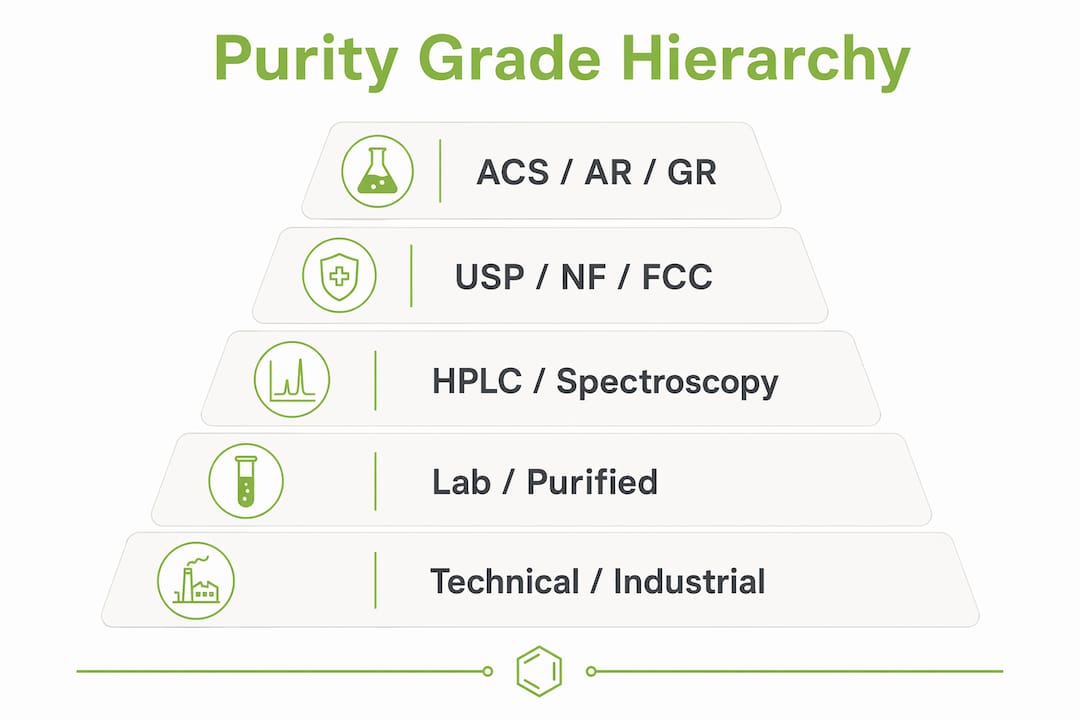
Chemical purity is organized into a hierarchy of grades that match specific application needs, from the tightest analytical tolerances down to bulk industrial use. Each grade carries a different impurity profile, documentation standard, and price point.

ACS, analytical reagent (AR), and guaranteed reagent (GR)
ACS grade meets the specifications published by the American Chemical Society’s Reagent Chemicals monographs and is commonly treated as the highest standard for analytical laboratory work in the United States. AR (Analytical Reagent) and GR (Guaranteed Reagent) are often used interchangeably with ACS grade; all three denote chemicals with tightly controlled impurity limits and a Certificate of Analysis (CoA) that lists the actual tested values. These grades are the default choice for quantitative analysis, titrations, and any method where trace contaminants would shift results.
USP, NF, and FCC grades
Pharmacopeial grades (USP and NF) and the Food Chemicals Codex (FCC) are required when a chemical will be used in drug manufacturing, pharmaceutical compounding, or food-contact applications. They include current Good Manufacturing Practice (cGMP) controls, microbiological limits where relevant, and monograph-defined test methods. USP/NF compliance is enforced by the FDA for drug products; FCC applies to food additives and processing aids. These grades may not always exceed ACS in raw assay percentage, but they carry the regulatory documentation that ACS grade does not.
HPLC, spectroscopy, and electronic grades
These specialty grades are optimized for specific interference types rather than overall purity. HPLC-grade solvents specify UV absorbance cutoffs and particulate limits; spectroscopy-grade materials control background absorbance across defined wavelength ranges; electronic-grade chemicals (used in semiconductor fabrication) specify trace metal limits at the parts-per-trillion level. The CoA for each will list the specific performance test rather than a simple assay percentage.
Lab grade, purified, and practical grades
Lab-grade and practical/purified chemicals lack standardized impurity specifications and are unsuitable for pharmaceutical or food-contact uses without additional documentation. They work well for teaching labs, equipment rinsing, and non-critical preparative work where exact impurity levels do not affect the outcome.
Technical and industrial grades
Technical or industrial grades are sufficient for most bulk manufacturing, cleaning, and process chemistry where impurity levels do not affect the final product or measurement. They carry the lowest cost and the least documentation. For many B2B procurement decisions, this is the right answer.
| Grade | Intended use | Typical documentation | Key impurity focus |
|---|---|---|---|
| ACS / AR / GR | Quantitative analysis, reference standards | CoA with tested values, ACS monograph | Trace metals, water, specific organics |
| USP / NF | Drug manufacturing, compounding | CoA, cGMP records, monograph compliance | Heavy metals, microbial limits, residual solvents |
| FCC | Food additives, processing aids | CoA, FCC monograph compliance | Heavy metals, arsenic, microbiological |
| HPLC / spectroscopy | Chromatography, spectral analysis | CoA with UV/absorbance specs | UV-absorbing impurities, particulates |
| Electronic | Semiconductor fabrication | CoA with ppb/ppt metal limits | Trace metals at ultra-low levels |
| Lab / purified | Teaching, routine prep work | Basic CoA or none | Not standardized |
| Technical / industrial | Bulk process, cleaning | Typical assay only | Not specified |
How do grades actually differ in specifications and documentation?
Grade names are labels. What actually matters is the underlying specification: which impurities were tested, by which method, and to what limit.
Purity percentage vs. impurity profile
An overall assay percentage tells you the fraction of the desired compound present, but it says nothing about which impurities make up the rest. A chemical with a 99.5% assay could contain trace lead at levels that ruin an ICP-MS calibration or a residual solvent that interferes with a GC method. The impurity profile, not the headline number, is what determines fitness for purpose. ACS and USP monographs specify limits for individual impurities; technical-grade specs typically do not.
Analytical methods on the CoA
When a CoA lists specific test methods such as NMR, GC, ICP-MS, or titrimetry, it gives you real assurance about what was actually tested and to what detection limit. A CoA that states only “purity ≥ 99%” with no method listed is far weaker evidence. Mass balance (calculating purity as 1 minus the sum of all identified impurity fractions) is a recognized approach for high-purity reference materials, but it requires that all significant impurities be identified and quantified.
Grade name vs. SI-traceable value
A grade name like “lab grade” is a commercial label with no metrological standing. A NIST-traceable CRM carries a certified value with a stated measurement uncertainty, assigned through methods that link the result to SI base units. True analytical certainty depends on metrological traceability to the SI; for calibration standards and high-stakes quantitative work, a CRM is not optional.
Pro Tip: Request the specific lot CoA before ordering, not a generic certificate. Lot-to-lot variation is real even within the same grade, and a new lot can shift your baseline if you are running near a method’s detection limit.
Key items to check on any CoA or product page:
- Lot or batch number (must match the product you receive)
- Test methods listed for each impurity (not just “meets spec”)
- Actual tested values, not just pass/fail
- Laboratory accreditation or reference to the testing standard
- Expiration or retest date
How do you choose the right grade without overspending?
The right grade is the lowest grade that will not affect your measurement, safety, or compliance outcome. Here is a practical checklist to work through at purchase time.
- Define the performance requirement. What impurity level would actually change your result or create a safety issue? If you cannot name a specific impurity and a specific limit, you may not need a premium grade.
- Check regulatory and monograph demands. If the chemical contacts humans (drug, food, cosmetic), USP/NF or FCC compliance is not optional under FDA rules. Pull the relevant monograph before ordering.
- Choose the grade category. Match the grade to the requirement: ACS/AR for analytical work, USP/NF for pharma and compounding, FCC for food, HPLC/spectro for instrument-specific applications, technical for bulk industrial use.
- Confirm CoA and impurity limits. Verify that the supplier’s CoA lists the specific impurities that matter for your application, with actual tested values and the methods used.
- Consider CRMs for calibration. If you are building a calibration curve or validating a quantitative method, use a NIST-traceable CRM as your primary standard rather than a reagent-grade chemical alone.
- Compare cost and availability. For most industrial procurement, technical or industrial grades are sufficient; reagent and analytical grades add cost and documentation that are only necessary when impurities affect the outcome.
The cost difference between technical and analytical or pharmaceutical grades can be substantial, sometimes an order of magnitude for the same compound. That premium is justified when the impurity profile matters. For bulk cleaning agents, process solvents, or synthesis feedstocks where the product is further purified downstream, paying for ACS documentation is money spent on paper, not chemistry.
Grade selection in one sentence: if the impurity cannot affect your result, your product’s safety, or your regulatory filing, the lower grade is the correct choice.
What should you demand from a CoA and when do you need a CRM?
A Certificate of Analysis and a Certified Reference Material serve different purposes, and confusing them is one of the more common procurement mistakes in analytical labs.
A CoA is a supplier-issued document confirming that a specific lot of material was tested and met stated specifications. A strong CoA includes the lot number, actual tested values (not just “pass”), the analytical methods used, and the testing date. It tells you what the batch contained when it left the supplier.
A CRM is a reference material with a certified value assigned through a rigorous, metrologically traceable process linked to SI base units. NIST issues Standard Reference Materials (SRMs) and value-assigns CRMs through methods including quantitative NMR (qNMR), gravimetric analysis, and differential scanning calorimetry (DSC). The certified value comes with a stated uncertainty, which is what makes it usable as a metrological anchor for calibration.
| Documentary item | When it is required | What it answers |
|---|---|---|
| CoA (lot-specific) | Every purchase of a specified-grade chemical | Was this batch tested and did it meet the stated spec? |
| CoA with listed methods | Analytical or regulated applications | Which impurities were tested and by what technique? |
| CRM / NIST-traceable standard | Calibration, method validation, high-stakes quantitative work | What is the certified value and its measurement uncertainty? |
| cGMP manufacturing records | USP/NF or FCC-grade purchase for drug/food use | Was the chemical manufactured under pharmaceutical controls? |
Practical checks before accepting a CoA or CRM:
- Lot number on the certificate matches the label on the container
- Test methods are named (e.g., ICP-MS for metals, GC for residual solvents), not just referenced generically
- For CRMs: the certificate states the uncertainty and the traceability chain (e.g., NIST SRM or ISO 17034-accredited producer)
- Expiration or retest date has not passed
- Procurement decisions should prioritize documented impurity panels and traceability over grade name alone
Key Takeaways
Choosing the correct chemical purity grade requires matching the impurity profile and documentation to the application, not defaulting to the highest grade available.
| Point | Details |
|---|---|
| Grade name is not a specification | Always verify the CoA for actual tested values and listed methods, not just the grade label. |
| Fit-for-purpose is the selection rule | Choose the lowest grade whose impurity limits do not affect your measurement, safety, or compliance outcome. |
| USP/NF/FCC for regulated applications | Drug, compounding, and food-contact uses require pharmacopeial or FCC compliance; ACS grade alone is not sufficient. |
| CRMs for calibration and validation | NIST-traceable Certified Reference Materials are required for high-stakes quantitative work and method validation. |
| Chemlabshop-online for research-grade supply | Chemlabshop-online offers research- and reagent-grade chemicals with CoA documentation available, suitable for analytical and experimental applications. |
The grade name problem nobody talks about
Most purchasing guides tell you to match the grade to the application. That is correct but incomplete. The part that actually trips up labs and procurement teams is trusting the grade name as a proxy for the specification.
Grade names are not standardized across suppliers. One vendor’s “lab grade” is another’s “purified grade,” and neither term carries a legally defined impurity limit. The ACS and USP monographs are standardized; the grade names printed on bottles outside those systems are not. This matters most when you are sourcing from a new supplier or switching lots within a supplier.
The counterintuitive move that experienced QA teams make: they read the CoA first and the grade name second. If the CoA lists the impurities that matter for the application, with actual values and named methods, the grade label becomes almost irrelevant. If the CoA is a single-line “purity ≥ 98%, method: titration,” the grade label tells you nothing useful regardless of how it is marketed.
There is also a cost trap on the other side. Labs that default to ACS or HPLC grade for every purchase, regardless of application, routinely spend two to five times more than necessary on chemicals used for equipment cleaning, preparative synthesis, or student practicals. Technical grade is the right answer for a lot of routine work, and acknowledging that openly is what separates disciplined procurement from reflexive over-specification.
Pro Tip: For routine plant or industrial tasks, technical grade is often the correct answer. Reserve analytical or pharma grades for the specific steps where impurity levels actually affect the outcome, and document that decision in your SOP.
Research-grade chemicals and documentation from Chemlabshop-online
Researchers and lab professionals who need research-grade chemicals with supporting documentation can source directly through Chemlabshop-online. The catalog covers research chemicals and synthetic substances across a range of product variants, with pricing varying depending on compound and quantity.
CoA documentation is available on request, and orders can be placed by credit card or cryptocurrency, with a 20% discount for crypto payments. Worldwide shipping is supported, and the ordering process is designed to be straightforward for researchers who know what they need. For buyers exploring related product categories or needing documentation details before committing to an order, the product pages include variant options and specification information. Visit Chemlabshop-online to browse available compounds or submit a documentation request for your next research purchase.
Authoritative U.S. standards and reference resources
These are the primary sources to consult when you need specification detail, regulatory guidance, or traceability documentation for chemical purity grades in the United States.
- ACS Reagent Chemicals (pubs.acs.org): The definitive U.S. reference for analytical-grade specifications. Lists impurity limits, test methods, and acceptance criteria for hundreds of reagents. The standard against which ACS-grade products are measured.
- United States Pharmacopeia / National Formulary (USP/NF) (usp.org): Governs pharmaceutical and compounding applications. Monographs specify identity, strength, quality, and purity for drug substances and excipients. FDA enforces USP/NF standards for drug products sold in the U.S.
- Food Chemicals Codex (FCC) (usp.org/fcc): Published by USP; sets purity and identity standards for food-grade chemicals, additives, and processing aids. Required for food-contact applications regulated by FDA.
- NIST Standard Reference Materials (SRM) program (nist.gov/srm): The U.S. national source for SI-traceable reference materials. SRM certificates include certified values, uncertainties, and traceability statements. Essential for calibration and method validation in regulated environments.
- FDA Bioanalytical Method Validation Guidance (fda.gov): Covers the validation requirements for analytical methods used in drug development and regulatory submissions, including the role of reference standards and traceability.
- IUPAC Gold Book, chemical purity definition (goldbook.iupac.org): The internationally accepted definition of chemical purity as mass (or amount of substance) of a specified component divided by the mass of the system. Useful for understanding how purity is formally calculated and reported.
Check monographs and CoAs for method details rather than relying on grade names. The grade label on a bottle is a starting point; the monograph and the lot-specific CoA are the actual specification.


0 Comment